Showing posts with label nursing. Show all posts

Friday, September 6, 2013

Baby Out! PSORHN's First BORHN


Manila, Philippines - The Philippine Society of Sexual and Reproductive Health Nurses (PSORHN), a group of nurses who advocate and serve for SRHR in the county, had its hands full last week.  Three simultaneous events were happening - two in Metro Manila and another in Bagui. While PSORHN nurses were educating communities regarding sexual and reproductive health in Baguio, another group was at the UP-PGH Ortoll Center in Manila, being trained on inserting long-acting contraceptive, Implanon. 
 
In a not-so-distant location in the capital, PSORHN was conducting the first ever Basic Orientation on Reproductive Health Nursing (BORHN). Held at the Philippine Nurses' Association's (PNA) auditorium, BORHN is an entry-level training for those who wish to be RH nurses. It covers fundamental topics such as sexual and reproductive health, a primer on the Reproductive Health Law, and opportunities of nurses who will be specializing in sexual and reproductive health.

I had the pleasure of attending the pioneer batch of BORHN and despite being in the advocacy of reproductive health for several years now, I believe that BORHN a very comprehensive course that would-be RH nurses would benefit from. Here are some of the highlights of the course: 

1. The relationship of society's concept of sexuality to service delivery and promulgation of laws and policies; 
2. Treaties and international laws pertaining to SRHR; 
3. Major provisions of the RH Law, especially those pertaining to the practice of nursing, and the prohibitive acts; 
4. The opportunities for RH nurses.


Another batch of future RH nurses will be undergoing the BORHN training on the 20th of September. For more details regarding the training, visit the PSORHN website.

Hope to see you there!


Monday, July 15, 2013

Four Crazy Things I Found Through Research: Adolescent Sexuality, Religion, and Everything in Between


Hurray! This is my 28th blogpost! I’ve reached the number of post I had last year and it’s only July! I promise that there is more Codswallop to come. 

Now onwards with the post!

My work for the past few weeks has been centered on scouring the Internet to prove that there is an alarming increase in teenage pregnancy because of lack of information regarding reproductive health. That one is easy: I’ll just have to quote NSO’s press releases which state that there is a 65% increase in teenage pregnancy from 2000 to 2006.[i] My job also includes listing down the reasons as to why there is a lack of access to information. We all know that one of the most obvious reasons is that 81% of Filipinos is Catholic,[ii] but when your bosses include Lizzie Zobel and Alvin Dakis, the reason that “it’s common knowledge” is a reason crushed by skepticism that rivals an atheist’s when confronted with the argument of the existence of god. 

Hungry for knowledge (and honestly terrified of not being able to answer questions thrown during our revision exercises), I channeled Hermione Granger and ate up several volumes of Philippine Population Review, slept with a magazine on girls on migration, and scoured the Internet for anything from Papal Encyclicals to the Jo Imbong’s shiz about sex ed[iii]. And because I’m such a nerd, I’m writing this oh-so-special blogpost to share the happiness and the trauma I’ve experienced during my rabid online research.

Here are some crazy data that I found that made me question, react either with awe or violence, or look out into the horizon and ponder on the meaning of existence. 

1. 83% of Filipinos are on Facebook, Twitter, and other emerging media.[iv]
 
That’s 83% of almost 92 million people, ladies and gentlemen, and there are those who still underestimate the power of the social media to inform and influence. In this day and age of smart

And this tells us the reach – the power- of social media. In this day and age where a significant portion of Filipinos have smart phones, access to internet through their personal computers or through internet shops, many advocacy groups, government agencies, and even the Roman Catholic Church have Facebook and Twitter accounts. 

Just this Tuesday, the oral arguments were held for the Reproductive Health Law at the Supreme Court. Both pro-RH and anti-RH were Tweeting to keep people in the know.  

2. High cost of education and – get this – housekeeping are the top two reasons why girls drop out of school.[v]

I actually received flak from someone online when I posted this little bit of info online, saying that I was insinuating that girls should be lazy and not do housework. It drove me nuts for a couple of seconds, but there you go. I will no longer speak about the incidence.

The point: Why is it that the GIRLS are the ones shown to quit school because of housework? Why not boys?

The question: What does the study tell us?

The hypothesis: This stat has something to do with what’s between the legs. The Filipino culture, known for its patriarchal ideologies (despite ranking 8 in the world in terms of the Gender Gap Index) have stereotyped girls as the keepers of the house – despite the fact that today many women maintain jobs outside the house and are bringing home the bacon. 

One of the many literature I’ve read talked about the dangers of gender roles. In the news, we hear about the inequality of those with penises and with vaginas. The Philippines may be high up in the list of gender equality, but that doesn’t mean we have to stop working for it.

3. Empowered mothers tend to rear empowered daughters – and this means talking about sex.[vi]
 
What does it mean to be an empowered woman? Several things, according to this study – having an education and a career, being able to decide what happens around the house and - surprise, surprise - having the ability to make informed choices about one’s body. That, and being able to pass that knowledge to one’s daughter. In the study, it was shown that empowered moms would more likely advice their daughters to delay sexual initiation and give them the necessary sex ed to their children. 

4. Abstinence is more frequently talked about during integrated sex ed class than reproductive anatomy.[vii]

I shiz you not,dear Reader. Not using your reproductive anatomy is taught more than WHAT your reproductive anatomy is. 


My desk is a reflection how crazy I've become.


The Internet is an awesome reservoir of knowledge, and this past few weeks have been a learning experience for me. The multitude of data and information I was able to take in were eye-opening and had elicited a variety of emotions – like I said, from awe to violence – but most importantly, the job has made me look closer at what is happening in real life, it has made me question and seek answers.
If you’re interested in any of the stuff I talked about here, check out the linkies below for more cool/infuriating stuff about religion, sexual health, and young people. 
Knock yourself out.


[i] “Pregnancy among girls under the age of 20 increased by 65 per cent over a 10-year period, from 2000-2010, despite a reverse trend in teen marriages, which is on the decline, according to the National Statistics Office (NSO).”
[iii] “Supposing [a girl] says, ‘I think I love this guy, He’s my crush. He wants to be more intimate with me,’ and then she gets abused. That was her decision. She entered into it. There is already consent, therefore you cannot anymore charge the other person. See how dangerous it is?"
[iv] McCann International study on social media use: Power to the People Social Media Tracker Wave 3
[vii] In a study conducted by Merlyne Paunlagui, et. al. in 2005, abstinence was more commonly discussed than sexual decision-making (37.86%), reproductive anatomy (35.92%), contraception (30.10%), and risk reduction, which received the lowest attention at 25.24%.

Monday, June 24, 2013

Dealing Skin Asthma and Derma-Worthy Tips I Paid for (but You Get for Free)

It is a known fact that, between my brother and I, I got the nastier sets of genes. Sure, my Grammar is better than his and I am confident to say that I am more creative in wielding the written words, but he got the Math genes from my father's side of the family, while I struggled with it all throughout high school. The only thing that makes us genetically equal, really, is that we both have our father's dark skin. The trait is so damn powerful that the natural fair skin of 1/2 of our bloodline has perished completely. So much for being half Chinese. 

Both my brother and I have dark skin, which is okay, but only I inherited the skin asthma. 

I do. When April came and the hellish heat made us suffer for two months, I suffered more than the ordinary person because, unfortunately for me, my skin asthma trigger is the heat. To make the long story short, I was about as inflamed as I can get. 


Example of irritated skin. Dryness and redness are apparent.
This condition is not communicable but is a recurring annoyance. Itchiness occurs especially  in folds of skin where sweat is usually deposited. 


I'm not really vain (I mean, just recently, I got told off my the boss for not wearing make-up at work so now I have to wear lipstick so I don't look like death), but the condition was getting preposterous and it does absolutely nothing for my withering self confidence. Sometimes, when I go temporarily gaga, I forget the fact that I'm smart and talented just because I can't wear a particular dress. Conditions like skin asthma can really mess with the head and bring insecurity.

Thus, when I finally had the money, I ran to the nearest dermatologist to find out how I can get rid of this condition, lest I go mad and consider something bloody and drastic, like skin transplant. The entire ordeal, including the stuff I had to get if I wanted salvation from discomfort and embarrassment, cost me a whopping PHP1,700. 


Let me save you 400 bucks by sharing what the good doctor told me. The tips are pretty general and are also applicable to those with or without the condition. Here they are.:


1. Moisturize. Moisturize. Moisturize.  Dry skin is usually the cause of itching and irritation. The best way to prevent this is to drink lots of water, pack up on lotion and cream, and avoid long luxurious warm showers. If you're like me, the last one is a bit of sacrifice, but there you have it - arm water actually dries the skin. 

So how do you apply lotion properly? After taking a shower, pat your skin dry. Pat. Do NOT drag the towel against your skin, as the friction may cause more irritation. When the skin is still damp, slather lotion all over your face. Show the torso and the back some love too. 

The face need some attention too, of course. Moisturizers for the face are best in cream form. 

2. Choosing the right product. Products that are best for sensitive, "I-will-revolt-upon-use-of-the-slightest-harsh-chemical" skin are expensive, but trust me, it's worth the money. When looking for moisturizers and soaps for delicate skin, stick to colorless products. Stuff with coloring also means it has a lot of preservatives which can irritate skin. Also, stay away from perfumed lotions and soaps. 

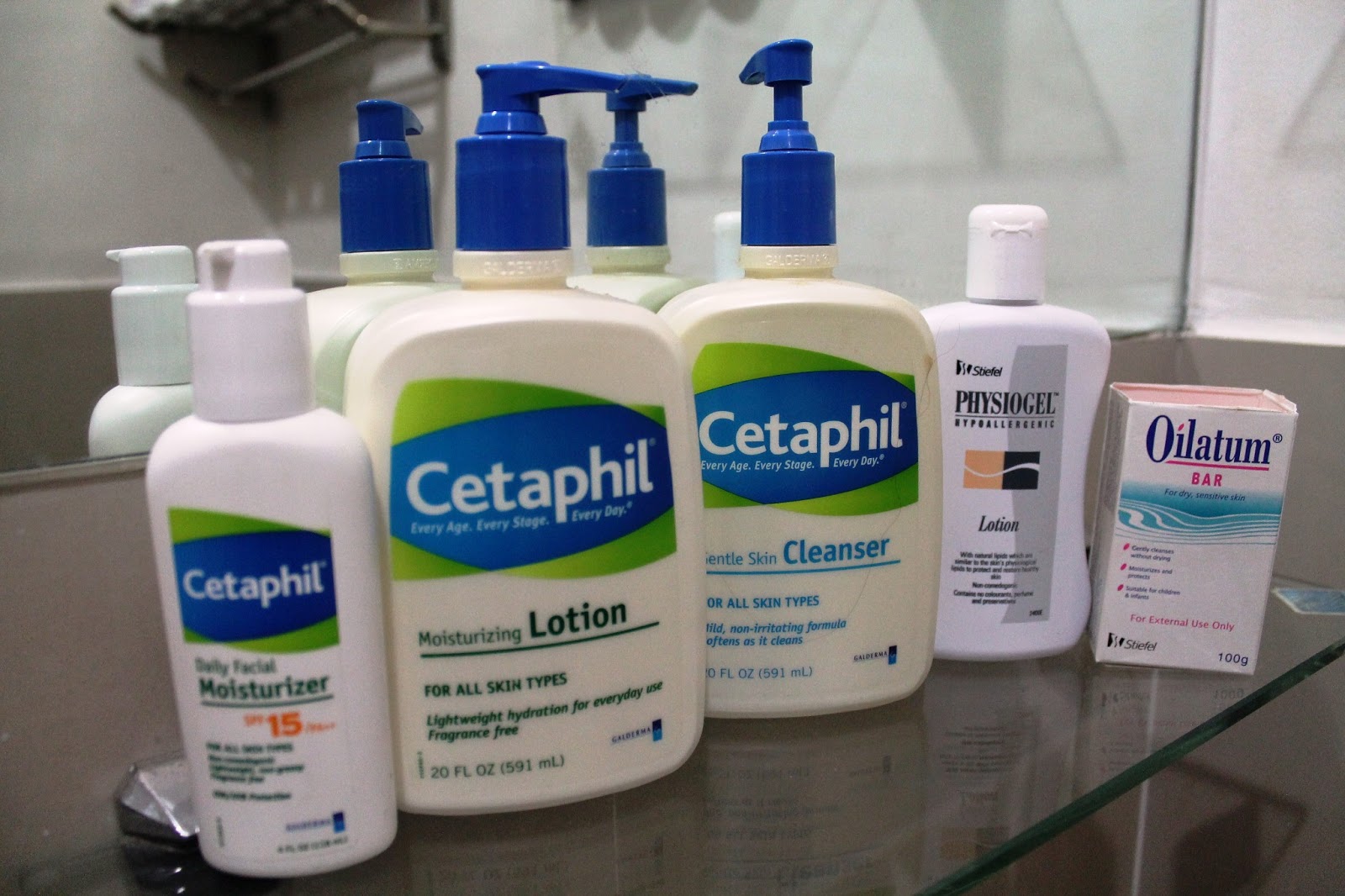
My arsenal against skin allergies: Cetaphil Daily Facial Moisturizer with SPF 15, Cetaphil Moisturizing Lotion, Cetaphil  Cleanser, Physiogel Lotion, and Oilatum Soap.
I love Cetaphil products, because they work really well. They don't come cheap though, but that's quality for you. The lotion is around 700 bucks up, but it really packs in the moisture. The skin cleanser is so gentle you can use it on babies. Physiogel lotion is around 700 bucks, and if you can believe it, that's now cheap. A few years ago, one bottle of that baby would cost you 900 pesos. The Oilatum bar soap is roughly PHP150 pesos. Other products you might want to look into are urea lotion (Nutraderm)a which is a bit cheaper than Physiogel, and Dove Extra Sensitive soap, which is only about PHP50. 


3. On the Issue of Skin Whitening. I love my beautiful Filipino coloring, but because of the onslaught of allergies, I now have some hyperpigmentation - dark spots. When I asked regarding treatments for whitening (just to have an even complexion - who wants to look like a dalmatian but dalmatians?) the doc said it's a no-no. Apparently, whitening treatments like bleaching and whitening products like kojic soap makes the skin dry and thus may exacerbate conditions such as mine. 

It's not as if people with sensitive skin can never get treatment for my dalmatian-skin, though. It'll just take a while. The first step is to rejuvenate the skin then gentler products can be used to lighten the dark areas. 

---------------------------------------------------------------------------------------------------------
The skin, as a part of the body, does not only serve aesthetic purposes but also physiologic ones, like protecting you from external conditions, pathogens, and injury.  Also, being able to feel comfortable in one's own skin (to not want a skin transplant, in other words), is a definite boost one's confidence.

And if you have skin asthma like me, I just have one piece of advice:

Don't forget the lotion. 

Wednesday, May 22, 2013

In a Nutshell: What I Learned in the AIDS Course

A/N: Below is my final essay for my online AIDS Course at Coursera. I completed the said course with distinction (hurrah!), with a final grade that I find to be acceptable. What is most important for me, though, are the things I've learned about HIV/AIDS. The final essay was to be a collection of 5 statements about HIV/AIDS that I found to be significant. Here they are. 


The weeks I spent on the AIDS Course at Coursera has strengthened my resolve as a health care practitioner and an advocate for reproductive health. Throughout the course, I have tried to create parallelisms between the international context of the disease, and the local situation in the Philippines, which still has an escalating number of HIV infection[i]. Thus some statements that I have chosen are in line with the Philippine context.


I have chosen five statements that summarize the most important things I have learned in relation to its significance to my work.


1.    “We live in a society that chooses not to talk about sex, let alone educate the kids (about) what engaging in sex entails, good and bad…I believe that young people are fully aware that HIV exists. I also believe they know nothing about it at all.” – Angelo Esperanzate, AIDS Society of the Philippines[ii]
This sums up the status of the Philippine society’s outlook on HIV/AIDS, exposing the vulnerability of the generally sexually-active but sexuality-ignorant youth.  This statement is important to me because of my belief that resolving issues on reproductive health, which includes HIV/AIDS, are a play of biological and societal factors. The biological factors that make HIV/AIDS such a devastating disease are continuously being addressed – the pathogenesis is being explored, vaccines are in development, biomedical preventions are being studied, utilized, and improved. However, I believe that HIV/AIDS will never be eradicated if primary levels of protection are not strongly instituted: preventing people from ever contacting AIDS through lessening risk-taking behaviors, especially unsafe sexual intercourse. This can be done through proper counseling and education, which will be very difficult, if not impossible, in a culture where the norm of keeping mum about all things sexual. The twisted culture of conservatism is rendering people ignorant about protecting themselves from the disease.

2.    “Because it inserts its genetic material into the chromosome, HIV cannot be eradicated without killing every infected cell.” - Eric Hunter, MD, Professor of Microbiology & Immunology, Co-Director, Emory CFAR[iii]
Image from aids.gov

I am one who appreciates the fantastically terrible processes of how diseases wreck havoc in the body, which is why this is striking to me.  As explained by Dr. Hunter in his lecture, HIV primarily targets CD4 T-helper cells (which Dr. Hagen calls “generals” and “conductors” of the immune system[iv]), thus rendering the immune system incapable of efficiently addressing other threats to healthii. This statement is a summary of how HIV/AIDS is a double-edge sword – allowing the disease to escalate means CD4 cells will die, but to achieve functional cure for HIV (or suppress viral load), infected CD4 cells would still have to be eradicated.
This statement is significant to me because it is a challenge to those who wish to eliminate the epidemic: HIV is a terribly intelligent disease – your move, science.
And the answer is “bring it on”.


3.    “HPTN 052 is a game changer.” – Michael Sidibe, Executive director, UNAIDS.[v]
Dr. del Rio’s lecture about Treatment as Prevention (TasP) presented the HPTN 052 study, which unearthed wonderful results in terms of biomedical HIV prevention: total relative reduction of HIV transmission through TasP is 96%.iV The result yielded is incredible. This statement is significant because it reinforces one of the most important thing that I have learned in the AIDS course – that a Person Living with HIV (PLHIV) need not be feared, that with proper treatment, these people can line relatively normal lives and the chances of passing the disease to others is greatly diminished.  
It is a statement that, in my opinion, brings hope to PLHIV and those who advocate with and for them.

For those interested to read up on the study, look it up here.


4. “The Body of Christ has AIDS.” – Denise Ackerman, woman theologian.[vi] 
Ackerman’s statement is a bold, wonderful dare to the conservative views of some religions factions in dealing with HIV/AIDS and the discriminatory tone some religious groups took in the earlier stage of the epidemic. It is also an epitome of how religion can be a driving force for eradicating HIV/AIDS. In Dr. Blevins’s lecture, he mentioned that religion can either promote an environment for the spread of HIV or for stopping the infection in its tracks.vi This is one of the most significant statements for me because it is generally applicable to my country.

The Philippines the only Catholic nation in Southeast Asia, and the new cases of HIV infection are rising. Despite the clause for the separation of Church and State[vii], the Roman Catholic Church still has indirect power in terms of policy-making and has exercised this power to prevent the Legislative from passing bills that would provide comprehensive reproductive and sexual health education and services (although after years of battle the Reproductive Health Law was passed last year). Religion stands against informing the public regarding safer sex practices beyond abstinence. This is one of the reasons seen by reproductive health advocates for the increasing HIV infections.
This statement is the banner of any activist-advocate wishing to turn the tides and utilize religion to fight against the HIV epidemic.

5.    “Live HIV Neutral”. – The Stigma Project[viii]
Image from The Stigma Project


The final statement is from the Facebook page of The Stigma Project, and it reminds me of something I’ve heard a long time ago: that we are all living with HIV, regardless of our sero-status. HIV is a societal disease as much as it is a biological one. This short-but-powerful statement is important because of its double meaning: that PLHIV can live as normal as possible (thus “neutral”) and for those with sero-negative status to let go of discrimination and see HIV/AIDS from an objective and scientific position, instead of a condemning one (again, being “neutral”)


To conclude, AIDS is a muti-faceted disease which affects the society as much as it affects society. Information is vital to combating this epidemic and one must look at the information presented with objective eyes an open mind and an understanding heart.


[iii] Hunter-HIV Pathogenesis video lecture
[iv] Hagen-Immunilogy 101 video lecture
[v] Del Rio – Part 1: TasP video lecture
[vi] Blevins – Part 3: Social History of Religion’s Influence video lecture

Tuesday, April 9, 2013

AMUMA Editorial: For We are Fire


A/N: This editorial was supposed to be published in the Amuma, a magazine that is planned by the Alliance of Young Nurse Leaders and Advocates. As editor-in-chief, I was the one who wrote this article. This piece might not be published soon, but since it only seems fitting, I am sharing this in my blog anyway. Please note that despite being Amuma's editorial(which means the collective opinion of the staff), I was the one who wrote this and it is now published in my blog. Thus, it may no longer represent the insight of Amuma's editors and writers. 


Perfection is a myth and many times in an organization’s, there will be those who will take note of a group’s imperfections and believe themselves capable of augmenting them. An organization with this kind of members – those rooted in both idealism and reality – is possibly meant for great things, simply because the people within it will never settle for mediocrity.

The Alliance of Young Nurse Leaders and Advocates is such an organization. We have seen our young group blaze through the opposition of many, in order to fight for what we believe in and for the people we advocate for. Our voices have been heard, and what we have to say has gotten across. In our three years f existence, AYNLA continues to prove that it is as much talk as it is action.

Nevertheless, it is not without faults, and the national election is proof of this. The fact that our members participated enthusiastically, as voters or candidates, is an indication that they have been trained to not overlook wrongdoings and to strive for betterment through both words and actions. It sends a message to our leaders: Do not be complacent. We are watching you.

The organization welcomes this. It recognizes everyone’s ability to contribute to the organization’s goals. However, two things may inevitably stem from this: either a call for action that will benefit the organization or a mindless struggle for power that may lead to the destruction of our group.

The latter has happened to many other organizations. Often in the name of change, many potential leaders become blinded by their quest for power. The resulting action is below them: in the struggle to take control, their professionalism is eclipsed by greed and arrogance.

There shall always be the struggle for power. There will always be people who seek reform. The Alliance welcomes this. It is a sign that everyone is empowered.
The Alliance burns with the drive of advocacy, but its leaders (for, in AYNLA, no one is just a member) are faced with this dilemma: shall we direct our fire to our goals, or direct it to ourselves?

You decide.

Sunday, April 7, 2013

How to Keep Your Heart from Breaking

And no, I'm not talking about that figurative thing we all blame whenever we love and lost (the culprit's your brain, by the way), but that amazing beating four-chambered organ that brings precious blood to your cells and keeps you alive. That, and the arteries that act as roads and highways for what I, as a self-proclaimed frustrated poet of the allied medical profession, call as the Elixer of Life. 

One thing I learned from Nursing school is that when  the cardiovascular system (heart, blood vessels, and blood) fails, everything goes down the drain eventually. This means that any disease affecting these organs can lead to the end of life as we know it or simply to the end of life. According to the Department of Health, the top two causes of mortality in the Philippines are heart diseases and vascular diseases (1). Hypertension is one of the conditions afflicting the cardiovascular system, and is also the focus of the World Health Organization's 2013 World Health Day. 

WHO Banner for 2013 World Health Day

Hypertension is a condition wherein the pressure of the blood inside the arteries are above normal. The bad news is that a high BP can cause stroke, kidney, and heart problems (2) All over the world, diseases which root from hypertension have killed billions. The good news is that since hypertension can be caused by many lifestyle-related factors and it is also preventable. 

Basing from the causes of hypertension here are some non-meds ways to prevent (and control) BP shoot ups: 


1. Junk the chips and nibble on rabbit food. 
 I don't know about you, but there is nothing more refreshing to me than a nice crispy apple to snack on and I'd choose orange juice over cola any day. I like junk food, but real food is still the best. Processed stuff and fast food are high in salt, which is used as preservative and flavor enhancer. Unfortunately, sodium, a main chemical comprising regular table salt, is a water retainer. Like my critical care nursing instructor said, "where sodium goes, water follows". Water is usually good for the body, but too much water increases the blood volume unnecessarily, which does not only put a strain on the heart, but also increases the pressure in the arteries. 

2. Turn off the TV (or the computer) and explore the world.
I am as addicted to Facebook, Pokemon, and the Wikipedia-ing random stuff, but this kind of past time is a huge contributor to unwanted tummy fat, which is a health risk as well as unflattering. Most people in an 8 to 5 job are already spending too much time sitting around with very little physical activity. As much as I love seeing my Charmander evolve to its fearsome last form like the next nerd, spending the weekend in the same position and barely moving is not good. This is actually a pretty serious problem. I mean, honestly, how many hours do YOU spend on Facebook, or playing online? 

Obesity is a major risk factor in developing cardiovascular diseases. Fat plaques build up around arterial walls, narrowing the vessel and rendering it less flexible. The result? High BP.

3. Get a-movin'!
If you're like me, you're probably financially poor and forever busy. This means that you, like me, have neither the time nor the cash to get into a gym. That sucks, but that's no excuse to not get any exercise. Walk, use the stairs, and, instead of working out on a stationary bike, get on a real one and use it to go to work or to the market. Not only will you be much healthier because of the physical activity, you'll also saving mother nature and yourself from bankruptcy secondary to gym dues. Good deal. 


4. Be happy.
Being pissed off is NOT good for your heart. The adrenalin produced when a person is angered increases the heart rate (thus, the volume of blood pumped out) which leads to the blood pressure shooting up. 

Chill. Being angry all the time can't be good for you. Breathe deeply for ten counts. Do yoga. Meditate. Read a book. Watch Alex Goot on Youtube and enjoy good music. Go to a buddy and tell jokes and laugh. Sleep on the beach. Exercise catharsis through blogging about your anger and negative emotions. Or if you're like me, spend 10 minutes just standing in the shower, literally chilling. 


I hope these reminders are helpful in controlling your blood pressure and safeguarding your heart from breakage via hypertension. Remember: being healthy doesn't have to be difficult. 

From us at the Philippine Health Bloggers Society, Happy World Health Day!


Layout by Nr. Alvin Dakis, PHBS Founding Chairman


Sources: 

1. http://www.doh.gov.ph/node/198.html 
2. http://www.nlm.nih.gov/medlineplus/ency/article/000468.htm