Showing posts with label Blogging. Show all posts

Friday, May 9, 2014

PHBS Workshop:Blogging It and Owning It

#PHBSPart2

I had an AWESOME weekend. So awesome that I'm going to write more than one blogpost about it.

May 3 was the Philippine Health Bloggers Society's Blogging for Health and Wellness workshop. This event was made possible by our awesome partner, Zoomanity Group (literally the happiest place on Earth, ladies and gents), and our sponsors, GLI, Elabram Systems, Gardenia, and Victoria Court. The event was covered by FAME Publishing, Tribune Post, and Kipling Times.

I was also one of the speakers of the said event. It was quite a privilege to be speaking to my fellow health bloggers and those who want to be online influencers for health, so of course I prepared slides (I'm teacher-y like that)! Now I'm sharing them to you. 


In the Philippines, if you want to write about health and you only have eye for the surface, you're essentially stuck with the same topic. You and the rest of the health bloggers will be talking about the same banana.


...And so here is our question. This question was something I asked one of the awesome panels in iBlog 10 and they gave me some ideas on how I can be different. But given that I like doing my own research and contemplations, I was also able to come up with answers to my owl question. Tanong ko, sagot ko lang ang peg.
 Read more about iBlog10 here.

The thing we want to know about health is that it's not just something physical, but is all-encompassing. A person can't be called healthy if he or she is not physically problematic but has issues on adapting to society (read: psycho). This definition leads to what health in the eyes of a health blogger can be about.
Health is something that is affected by society. And blogging about health doesn't mean you just blog about diseases, it means blogging about policies, practice and people.
And so we go back to this question... and I have three suggestions you may want to consider.
Like I said: health is an all-encompassing topic and most bloggers have just scratched the surface. Why not look into what other things may affect health and write about that? Or about arts and literature present health? Or the how a passion for fashion is related to wellness and disease? You might be surprised about to find out we health bloggers have so much to write about. This is STEP 1.
Look into what other people are writing...and then write something else. Don't stick with just the surface. Dig.

We have a MEMEMEMEME culture in social media. We post pictures, experiences, and thoughts, many of which are self-centered or at least coming from the self. Social Media, after all, is an avenue to be heard. Blogging is about telling your stories. But it can also be about telling stories that are worth telling, like one of our speaker, Ma'am Inday, said. Moreover, we can show our readers stories through different eyes.
Stories of other people are sometimes better than your own. And stories and general can sometimes be better shown through someone else's perspective.

If a blogger is writing about HIV/AIDS for instance, he or she may write from the perspective of an expert and give information regarding the infection. This is how we commonly do it. You can even check out my stuff abour HIV/AIDS and see I tell stories through the perspective of an advocate who shares information. But what about the other side of the story? What about the story of the Person Living with HIV (PLHIV)? Wouldn't it be interesting to know how they survive the infection, how they deal with social stigma? Wouldn't it be wonderful to understand how these people, who are sometimes seen as having a death sentence already, are becoming purpose-filled contributors to society? Also, what is the story behind their support system - their partners, parents, and friends? So many stories could be told, if we just tell these with different voices and from different perspectives.

Whenever I read stuff made by my favorite authors, I would almost always hear their voices in my head. Psycho, I know. J.K. Rowling, for instance, is known to me by her black humor. Karl de Mesa can say "fuck", talk about flayed humans, and incest but still sound way too elegant to be crass. I don't know how he does it, but he does it. Ana Santos is always informative with a touch of sass.

This is what I learned: If you want to stand out, you should have a voice. Is your voice sarcastic or malandi? A combination of sarcastic and malandi like mine?

Whatever that voice is, it gives personality to your writing. You have to let it shine through.


You are your blog and you are your brand. Make sure that it shows.


Tuesday, April 29, 2014

PRESS RELEASE: PHBS, Zoomanity Group to Host Free Health Bloggers Workshop

Janina: This is it, pancit! PHBS blogging workshop is this week and I am so excited! So much so that I have three consecutive sentences ending in exclamation points!

First, I would like to thank the wonderful people I am working with to make this event possible: Ate Grace Nicolas for hooking us up with our awesome partners;  Ate Jofti Villena for all your hard work in coordinating with our speakers; and my bhebhe Drei dela Cruz, for being the catalyst of this event, for helping us make the certificates and posters, for finding sponsors, and for being one of the best people I get to work with. Mahal ko kayo *Ms. Universe Wave*.

On with the press release!


To hone the skills of online influencers of health, the Philippine Health Bloggers Society has partnered with Zoomanity Group to hold its first ever workshop, Blogging for Health and Wellness. The free event will be held on May 3, from 7AM to 4PM. Health bloggers will be in touch with nature as they spend the day learning and relaxing in Paradizoo, Tagaytay City.

 “Social media and blogging are powerful platforms for advocating for health,” said PHBS president Janina Santos, who is also speaking at the workshop. “This initiative is truly a group effort of the Society. Our working group has been very passionate in putting this thing together. But of course, this would not have been possible without all wonderful people supporting our cause.”

Health bloggers are in for a treat as their transportation, venue, and food are shouldered by Zoomanity Group, while top brands in the business industry such as Elabram Systems Group, Gardenia Bread Philippines, Inc., Victoria Court, and GLI have also offered support. The event shall be covered by media partners FAME Publishing, Tribune Post, and Kipling Times.

Blogging for Health and Wellness also features speakers from the blogging and journalism industry who have years of experience and knowledge to share. Included in the roster of trainers is Ms. Inday Verona-Espina, Campaigns Director for the Philippines of Change.org, and Michaela Sarah De Leon of Health Beat Magazine. Joining them are marketing and brand specialist Engr. Grace Bondad Nicolas, nurse blogger and PHBS Founding Chairman Alvin Dakis, and PHBS President Janina Santos. The workshop will cover topics like starting a blog, making profit from one’s blog, creating good content, and, something every veteran and newbie blogger should know, the intricacies on online libel.


The Blogging for Health and Wellness workshop is one of the many activities the PHBS is planning to help build a community of online influencers who will advocate for health.


For more details, you may get in touch with Janina Santos.
Cell phone number: 09054167233

E-mail address: janina_santos54@yahoo.com

Monday, April 7, 2014

Dear iBlog10: (Channel Tom Cruise and Say) You... Complete... Me...

The PHBS: Likes, Andrei, Raim, and Ate Grace Nicolas at #iBlog10 <3 b="">


I took a leave of absence on April 4, which meant that when I get back to work, a tower of paperwork would await be on my desk. The probability of it being several towers is quite high. I woke up at 4AM and dragged myself to the shower. I left the house at 5:30AM to make sure that I don't kill myself in the morning MRT rush. As I made my way to UP Diliman, my head was filled with bittersweet memory of the place. In between reminiscing I nodded off, exhausted at having to wake up so early when I slept quite late the night before. 

Why the sacrifice you say? One word: iBlog 10. 

Last year, I also attended iBlog with the Philippine Health Bloggers Society. Here's a bit of a throwback:

From L-R: Raim, Hussein, Yours Truly, Drei, and Erick.


 This year, I was only able to attend Day 1 because April 5 is my mom's birthday. But Day 1 was more than enough to convince me that the sacrifice was quite worth it.

Let me tell you why: Like my blog (Codswallop) I am also a niche-less writer. As a freelancer, I've experienced penning down everything from marketing paraphernalia to website content offering different services to articles about improving one's English. I've written business proposals, letters for lobbying a certain ideology, press releases, text blast for marketing, poetry, short horror, literotica, love stories, and even Facebook posts for advertising purposes. I've also written a lot for advocacy, which is obvious in this blog. That's a whole lot of Codswallop.

Which is why attending iBlog 10's Day 1 was perfect for me. Sure, I fell asleep a couple of times (damn exhaustion), but being able to hear all of the speakers talk and - le gasp - covering almost ALL the areas I work on as a writer and blogger is just so amazing. 

Here's how Day 1 went: 

In the first talk, two familiar faces took to the stage: Carlo Ople, who was one of the moderator the TG Guingona's Cybercrime Law forum I attended a couple of years ago, and Mom Blogger aka Ms. Naomi Lardizabal Dado, who I during an interview with Risa Hontiveroz. In their talk abour Bloggers as New Media Personalities, they shared their experience as they transition from bloggers to online bringers of news.

Mom Blogger, in particular, shared with us how she started blogging as a form of healing when her son died. She also shared her transition from blogging about her personal life to informing people about certain products and lastly, her work at Blogwatch, in which she focused on educating netizens regarding the Philippine politics and other social issues. 

Carlo Ople was one of my personal favorites, especially when he showed us an online venture he worked on called  "Bury the Past Project". Apparently the Philippines is Sex Scandal Capital of the World, and with some savvy SEO tricks, BPP pushes down sex scandal sites down three to four pages. Cool. Here's a picture of Mr. Ople and all his coolness, giving us (relatively) young bloggers advice:

Sir, yes sir! :)

The next couple of talks centered on the building online communities and digital marketing - which was why my cool boss, John Lalic, should have been there. We both would have picked up something cool. 

In Building Communities Through Blogging, the Azrael Coladilla talked about spreading one's blog's network by involving new contributors who share the same interests, whereas Jinoe Gavan shared his experience in not only starting Takbo.ph, he also talked about the challenges and rewards of maintaining it. Vince Golanco, founder of When in Manila shared how he started the website and, although rather hesitant, allowed contributors to add to content, thus creating one of the most popular blogs in the Philippines today. He also talked about the perks of belonging to community blogs, which suddenly made me want to try my luck. I wonder if they publish codswallop-y stuff?

Of course, since this was iBlog, free food was served for lunch and the PHBS people and I took our grilled chicken and C2 across Malcolm Hall to enjoy UP Diliman' sprawling greenery. We also had ice cream before going back to the hall for the afternoon talks. 


The next topic was really interesting for me, because it zeroed in on Digital Marketing. The panel was made up of Ate Grace Bondand Nicolas, Jonel Uy, and Fitz Villafuerte. Real interesting stuff and I suddenly wish my boss was there. Being the eager-beaver-Hermione-Granger that I was, of course I asked questions. 

At this point, I have to apologize. Not only did I zonked out (I swear, I'm narcoleptic), I also had to step out because of an emergency at work. Calls, cusses, and giving my teachers some virtual (platonic) love for handling the situation the best they could were in order. When I came back, I had missed the entire talk on Interner Marketing and Advertising (which was done by Jeoff Solas, Manniz Borromeo Pabalan, and Brad Geiser)

Their talk was followed by something much closer to my heart: Blogging as Activism. Delivered by Tonyo Cruz and Francis Acero, the cruz of the talk was heart shattering and simple to the point that it almost (literally) drove me to tears:

Aye!
Day 1 of iBlog 10 ended with a bang (well, with a raffle, but that's kind of the same, really) and exhausted as I was, the event was worth. I would definitely go back next year!

Oh wait, did I mention that I happen to win an iBlog shirt from the raffle? Which made ALL the other PHBS members temporarily hate my guts. Which is fine. The Red Queen in Alice in Wonderland, played by the wonderful Helena Bonham Carter, did say "It is better to have a shirt than to be loved" or something along those lines.

PHBS members deserted me in the middle of taking this photo, because that white thing I'm holding - that's an iBlog10 shirt, friends and neighbors!


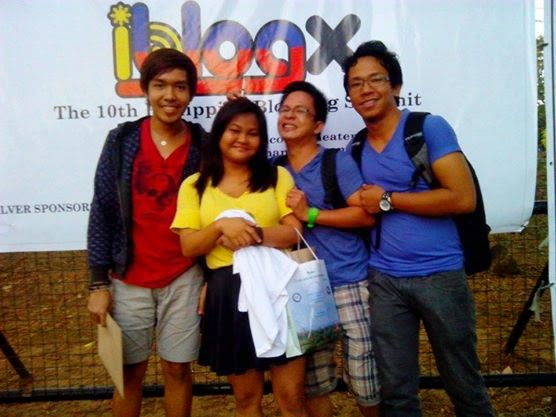
More PHBS vanity at the iBlog poster outside Malcolm Hall.


The Queer Ranter Raim.

Me with the Nurse Tambay, Drei.

Drei with Random Nothingness Owner Erick.


 I can't wait for iBlog 11!

Friday, March 21, 2014

The Importance of Shutting Up


It was my brother who taught me how to love animals.

When I was young, he would take me to empty lots around our subdivision to catch dragonflies. He told me that there was a crocodile living in the creek near our house.  When we got older, my brother would always take me to Cartimar, this little place in Manila known for selling birds, cats, fish, and dogs. We would go around and hang out with his fellow pet enthusiasts.

Was I surprised when his interests turned into reptiles and other exotic animals? No. Was I surprised that he started going on several trips, climbing mountains, to take pictures of the local wildlife? Not one bit. Did I find it amazing that he became a resource person of a show about Philippine wilderness and whatnot? No. My brother, who has a Masters in Public Administration and who worked his butt off to get his PhD in Educational Management, has always been destined to be awesome (I'm his sister after all).

My family and I during my brother's graduation. 


My brother’s love for the local wildlife meant that he has worked to ensure that we normal people are aware of the existence of the diverse fauna endemic in our country, as well as to preserve the said exotic animals.

This love is most likely the reason for this scathing status:


A Thin Line Between Public Service and Self Service

I have always believed in that writers, regardless of whether they tell fiction or non-fiction stories, are obliged by their craft to tell the truth. Writers who are journalists are even more compelled to do so. It is their work. It is their calling. It is their mandate. But like any job, telling the truth should be done with caution. Case in point: The Quirino Grand Stand Hostage Crisis. Hong Kong has yet to forgive the Philippines for that not-so-hospitable end to the tourists. 

If there is one proof that sometimes truth can be used in the worst of ways, it is this. 

When I was in high school and during the media training for RH that I attended, one important thing was drilled onto me by my teachers and trainers: responsible reporting. This can mean several things, and here are just some ideas that can be related:

1. Accuracy is the name of the game. This means that before a writer writes he or she must check sources, get in touch with experts, and make sure that whatever and however the piece is written is not intellectually dishonest, whether you meant to do it (for agenda setting - not cool, man) or not.

2. Protect your source. This is where confidentiality comes in. Say you're writing about a crime, like the PDAF scandal. It's often very tempting to say that you got the scoop from the mistress of a senator, or a perpetrator's brother in law, but sometimes, there are more important things that sensationalizing your story with undertones of betrayal, immorality, and sex. Your source could be risking more than their relationship with the people they choose to be a snitch to, they can very well be risking their lives.

3. Some truths are not meant for public ears. There are certain information that, if made public, such as the name of your source in some high-profile crime story, the identity of a rape victim (especially that of a minor), and the location of the Philippine Orange Tarantula, especially if your source has explicitly asked you to not divulge such information because it may lead to endangering the species. 


Many people use the banner of public service to rationalize voicing their opinions and telling truths. I believe in this. But sometimes shutting up is just as important as speaking up.

If, in disseminating the truth, you have hurt or endangered other people's lives or have compromised something that is good, then you might just be self-serving instead of people-serving. And as much as good writing, a nose for the news, and an instinct to get to the bottom of an issue are qualities of a good writer-journalist, I think learning when to shut up should be given as much value abovementioned traits.


Wednesday, March 19, 2014

PRESS RELEASE: FAME to host Bloggers’ Night event in Taguig City


Following the success of its event last year, Friendly Alliances and Media Expression (FAME), Inc. will host another one-night fellowship for renowned bloggers from food, lifestyle, entertainment, health and wellness, fashion, photography industries on March 19, 2014, 6 p.m. at the Megaworld Showroom, McKinley Hill in Taguig City.

Dubbed as Bloggers’ Night: Tagged, the event will feature FAME brands alongside with its corporate partners and supporters.

FAME has gone a long way from having only a doctor’s passion to write – a passion that turned to a vision of spreading a word on health and wellness in the country.

Abiding by its mission to promote good health, a healthy lifestyle, sound Christian values, and professional excellence, FAME has become a trusted brand in creating quality publications and providing other services in the country.

Owned by its very own Editor-In-Chief and Publisher, Dr. Rafael R. Castillo, a renowned cardiologist by profession, FAME started by giving its doctor-readers the Health and Lifestyle (H&L) magazine, the quintessential guide for the modern-day doctor, which is FAME’s flagship publication.

Two years later, FAME expanded its publication and ventured into commercial publications. DiabetEASE magazine was launched to empower patients and their families with diabetes.

From feature and in-depth stories on medicine, FAME ventured into promoting Philippine and international tourism and empowering women with Travel Plus and Zen Health magazines.

For more than two years now, Vital Signs, one of the latest FAME publications in an eight-page newsletter-format, is seen to become the leader in medical news as it synthesizes the most recent scientific and healthcare news taken from notable sources in the field of healthcare, medicine, and public health administration read by doctors, healthcare professionals, and even legislators. 

So what are you waiting for? Mark your calendars, come along, and tag your blogger-friend! You surely don’t want to miss this year’s Bloggers’ Night event as exciting prizes await all attendees courtesy of FAME’s major sponsors and surprise guest appearances and performances.

We hope to see you at our best event ever! 


For inquiries, concerns, and comments, contact Godfrey Santos at 0917-8787367  or Mica at 0908-4985066.

__________________________________________________________________________________________

CODSWALLOP is going to be here! See you, fellow bloggers! ^_^

Wednesday, December 25, 2013

Wrapping Papers and Writing (Why Blogging About Health can be as Sari-Saring Kalamay as Possible)

Codswallop means nonsense, and I chose this name for my blog because when I started writing, I knew that I would never be confined to just one topic, that this blog is meant to be a combination of all things I feel strongly for. 

Codswallop is a niche-less blog, which is probably why it's not popular. Or perhaps people just don't enjoy my writing? I honestly don't care much (but thank you, dear Reader for staying through my insane ranting...much love!). I write because I have something to say and because I don't I will literally turn psycho. That is enough for me. Despite being niche-less, I tend to focus on several topics that I hold close to my heart: advocacy for sexual and reproductive health and rights, women empowerment, and social and political trends and change. Occasionally, though, you'll find that I've gone insane and I've written about make-up and the arts (literature, my short stories, craft and the like). If I've really gone over the edge, I'd probably post something about my love life (or the lack thereof). Hey, it's my blog.


I've been blogging for four years, but have only seriously done it for 2 years. I've been writing since I realized that you don't become a writer - you work your arse to be one. That was when I was in Grade 4, about 15 years ago (damn I'm old). This post is merely to share my insights about writing.

Here are a few points:


1. There are no original stories, only original angles.This is something I've learned from attending several writing workshops. Whether the kind of writing I'm learning is literary or journalistic, this always comes up. The story you're writing is the same story another writing is writing. The plot you've thought of might have been used already. Just think of the parallels of The Hunger Games and Battle Royale. And if you're covering a story, you can be sure that someone else is covering it as well. When it gets published, it's quite possible that what you've written mirrors what somebody else has. 


There are no original stories. In literature, we try and go around this little unpleasantness by turning to a plot-driven and/or character-driven technique. The way a character reacts to a kaskas plot makes the story more interesting. For instance, a husband and wife having difficulty getting pregnant is a typical story. We've seen it a thousand times. A man and a mananaggal wife having difficulty getting pregnant is a different story all together. And then of course there is putting a spin to an old plot by devising some sort of twist in the end. 

So how do we make an unoriginal story our own? By attacking it in a different angle. We see this in many feature stories. If, for instance, we're writing about Lito Atienza's contraceptive ban in Manila, we will probably find stories containing the 5Ws and 1H - a typical straight news. We will also probably find a story of a woman with 9 children who doesn't want to have more but is once again pregnant because she can't afford to buy a condom. Same story, different angle.
2. Health is an interdependent issue. As a nurse, this is something I know in theory and practice to be true. Nurses are everywhere, and those who believe that we are only meant for the hospital are in serious need of a re-education. Health is so intertwined with the many aspects of human life that to talk about health effectively, you must be willing to touch those which affect it.

Last year, I was lucky to have been part of the volunteer team of the Forum for Family Planning Development. The Forum staged a play at Greenhills called The Vagina Monologue (in Filipino). This play is well known all over the world. The play told different stories of vaginas, but ultimately pinpointed the disgust, the hesitation, the the refusal of saying the word vagina and talking about the issues connected to it. This is in particular importance because in the world of sexual and reproductive health and rights, patient education is one of the most important elements. Unfortunately, in a culture which propagates malice in uttering names of body parts related to sex, patient education becomes ineffective.


http://vdayinmadison.files.wordpress.com/2012/02/vagina-monologues-2.jpg

This year, I was lucky enough to have finished a 9-week course on AIDS. The first three weeks were hardcore science, but we eventually came to lessons on changing ideologies and action as a form of preventive measure against HIV. One of the things we discussed was Scenarios from Africa, a group which makes films. Yes, I was taking an AIDS course and we talked about film making. We even watched some and wrote reflections on it. The films made by Scenarios from Africa relate to the many aspects of HIV/AIS - from preventive actions to surviving the disease psychologically. You see, tapping the arts is quite important in information dissemination and health.

 If you're interested in reading more about what I learned from the AIDS course, you can also check up my write-ups here, here, and here. The second link will lead you to our discussion on Scenarios from Africa.


I have always been vocal about my criticisms regarding various religion. This is because religion has got its hands deep in the culture of a society - which means it affects the way of thinking of people, specifically by the ruling class, the legislators, the executive power. This is true particularlyin the Philippines. The RH Bill was dragged through congress for 16 years, contraceptive budget was all but abolished in Arroyo's time (Arroyo is a well-known ally of the CBCP), and now the RH Law is still under Status Quo Ante due to roughly 16 petitions, most of which filed by religious groups.


Kenneth Keng of Filipino Freethinkers in a bishop outfit. This satirical protest is both about secularism and the RH Law.


Literature is one of the driving forces of society. Don't believe me? Just how many kids have read the Harry Potter series? On the other end of the pole, just how many hormonal 13 year olds have read Twilight (excuse me while I suppress a shudder)? I am a fan of Filipino literature an, and if you rummage around my little Codswallop, you'll find some reviews of local books which I love. Recently, I wrote a review for Wakasang Wasak, which is a collection of novellas. One of the stories there puts emphasis on secularism and the RH Law. Talk about a badass social commentary.


http://a.wattpad.net/cover/5769530-256-k592407.jpg

When I was in high school and college, I went through what adults would call "period of teenage angst". I was a complete emotional wreck and parasuewed up suicidal stuff wasn't far from the surface of my head (along with pathophysiology of heart diseases and the suspicion that God had a screwed up sense of pretty). I turned to art: painting, doing stuff with my hands, beading, writing. It saved me from spiraling into complete depression. 

During my 4th year, I took up Mental Health Nursing and was quite lucky to go on duty at ethe Philippine Center for Mental Health. One of the first things we did with our patients was to give them paper and crayons. Apparently art therapy is pretty damn real. (So excuse me if I post gift wrapping stuff here. That is apparently a healthy thing to do. It keeps me mentally fit, which, according to the WHO is part of being healthy.)

Below is a picture of one of the paintings I did when  was in 4th year. It's Charles Mason inspired, with lots of rage and teenage agony in between. Mom had me throw it away because it looked demonic, according to her. Given the emotions I pulled it out from, I don't blame her for seeing it that way. Still, I'm quite glad I made it. It's called Eve.
 

3. Monotony is codswallop. If we're all going to write about the same thing, using the same style, the same language, and the same angle, then we, as writers, are destroying creativity. We don't need to exist as writers, only as someone who mimics the ideas of one main source. 

To fail to seek how to creatively tell the same stories - that, to me, is nonsense if you dare to call yourself a writer.

Keel blogging everyone.

Thursday, October 17, 2013

Sex Talk: Demanding SSS


In bed, if you want some well-deserved oral action, you coax and ask nicely. Unless your partner is a newbie, the kind who finds vaginal fluids yucky, or just a selfish jerk (and honey there are a lot of 'em), then he (or she) would most likely give in to your desires. After all, how many times have you given him head (or vice versa)?

In the Philippines, safe, satisfying sex is much harder to get...and I'm not talking about the Filipino's prowess in bed. The RH Law has been dragged through the legislative process for nearly 15 years, and the Filipino people, especially those who belong in the lower economic class, have had to deal with the alarming increase in teen pregnancy, the staggering statistics of new cases of HIV/AIDS, maternal deaths, and everyday headlines of violence against women and children. SSS (safe and satisfying sex) - or as we in the the Philippine Society of Sexual and Reproductive Health Nurses like to call it, sexual and reproductive health and rights - should already be at hand. After all, the law has been passed. But after several petitions in the Supreme Court by the anti-RH camp, it was placed in Status Quo Ante. This is like dangling a particularly scrumptious piece of bread in front of a starving child. Sadly, this metaphor is surprisingly adequate given that government-supported reproductive and sexual health services would not only make our men, women, and children healthier, it would also contribute to the economic stability of families and individuals. 

We all know the arguments of the Pro-RH - no need to re-state them here. The problem is this: we have an RH Law that is NOT being implemented, and everyday that it is being delayed, more and more women die giving birth, more and more people are at risk for early, unwanted pregnancies and sexually-transmitted diseases.

In response to this, the Forum for Family Planning and Development rounded up one of the most powerful groups to drumbeat the issue - media. I was lucky enough that, as member of the Philippine Health Bloggers Society and the Philippine Society of Sexual and Reproductive Health Nurses, I was tapped as one of the attendees of the 2-day media training and planning. 

The plan is simple: Get the media to demand for Reproductive Health. 

This was why the Forum organized Demand RH: Media Training and Planning, a two-day event held at the Manila Pavillion from September 28-29. 


Joining forces for RH


When I was younger, I wanted to be a literary writer and a journalist (which explains my admiration for Sir Karl de Mesa, but that, my friends, is another story), so you can imagine my happiness at meeting some of the veterans in print and broadcast media. The participants came from all over the Philippines, each with years of experience in telling news and influencing people. We even have people coming from Zamboanga. T These attendees had years of experience in the craft of telling real stories of real people. I felt quite privileged to be learning with and from them. 

There were also some pretty influential people coming from new media, which is being used as platform to advocate for Reproductive Health. My group, the Philippine Health Bloggers Society, was also part of the event. In attendance were Andrei Dela Cruz, Erick Bernardo, Grace Bondad-Nicolas, Neil Aguas, and Tess Termulo.

 PHBS convening for a #DemandRH media event proposal. I must say Doc Tess look ready for battle. Photocredit to Likes Manglal-lan.

 The power of the media - traditional or otherwise - has proven itself, time and again, in agenda-setting and catalyzing action. This gathering was Step 1 of what would be an all-encompassing campaign for demanding reproductive health. 

What Went Down

Day 1 started off with the Forum's Ms. Chi Vallido's review of the journey of the RH law, including her personal report of what went on in the Supreme Court during the oral arguments. I was simultaneously infuriated and entertained by some of the comments and questions made by the anti-RH camp petitioners and justices. Honestly, the idiocy behind the words would have all been very funny, if we didn't have mothers dying left and right because of the delay in implementing the law. 

We then had Atty. Clare Padilla, Executive Director of EnGendeRights, talk to u about her experience in defending the RH Law. Her manner of arguing for the law and points of contention against the petitions to have the law declared unconstitutional were brilliant and I very helpful for those of us who are rather vocal in our support for the law. The classic secular vs religious ideologies was brought up again, but the lawyer also highlighted constitution expert Father Joaquin Bernas's argument that the life of the unborn should not take first priority over the life of a person. This is also a premise to back therapeutic abortions. 

Our the  afternoon session was a surprise - we actually had a legit Catholic priest with us to talk about the RH Law. When he started his talk by saying "There is no Prince Charming", my doubts began to dissipate. To protect his identity, we shall call him Father Enlightened. He was rather a pleasant surprise. He was not as sassy as my favorite lady journalist Ana Santos, but Father Enlightened had talked of the dangers of gender bias with pretty much the same the broad perspective. Two very striking ideologies hit me quite hard: 

"You do disservice to the RH Law if you just focus on FP."

"The personal is political: Women are facing daily experiences of gender inequality constructed not by nature but PATRIARCHY and SEXISM."


Okay, so I already know this. But it's a pleasant, if not surreal, experience hear a priest talk like this. There were even things that Father Enlightened say that were quite romantic enough to bring back my hope for my own happy ending.: 

"Gender equality demands that we treat one another as an end and not just a means."


Among these wonderful bits of wisdom, Father Enlightened also shared how he defends the RH Law from religiously-rabid anti-RH. The key, he told us, was to fight fire with fire - to use religious doctrines to counter religious doctrines. The Dignitanis Humanae is an encyclical that is a good start. There are several other Church documents that the Pro-RH people can look into, such as the Life of the World (Pope Benedict XVI) and Pope John Paul's Letter to Women in 1995. The irony was sweet.

I have to say that Father Enlightened's talk was one of my favorite's. 

The last talk of the day was about combining gender sensitivity and media practice. Dianna Mendoza from the Rappler walked us through through creating pieces that consider the plight of women and that would highlight gender equality. This is of particular importance to me, because the Catholic Church, the main religion rallying against the Reproductive Health Law, has quite a network when it comes to media and thus agenda setting using both traditional and new media is easy to them. 

Day 1 ended with Chinese dinner and beer, and Likes Manglal-lan, fellow Emerging Youth Leader for SRHR, hanging out with me and Ms. Grace in our room. 

Day 2 of the Demand RH training was quite exciting for me. We had two speakers in the morning, the first one being Rochit TaƱedo. Ms. Rochit gave us several feature stories on SRHR scenarios, one of which is about a teen-age girl called Princess who got pregnant as a result of corrective rape. The girl was a tomboy. After reading the material, we performed an impromptu interview. I played the Princess, and another of our fellow trainee played a radio host who threw me interview questions. The exercise unearthed some pretty disturbing realities, primarily how calloused media personnel could be in the face of getting the news. It was a good analysis, especially since we also shared the good practices when dealing with sensitive cases like that of a rape victim. In addition, having read Ms. Rochit's pieces made me realize that a compelling story is a story with a face, and the human element is imperative to drumbeat the need for RH. 

One of my girl crushes, Ana Santos, was the last speaker of the training. CEO (Chief Empowerment Officer) of the fab website Sex and Sensibilities, Ms. Ana has always been my idol when it comes to writing about sex. She does it in a way that is neither too sterile nor too pokpok-like. Ms Ana brings the casual tone to sex talk, which is always a breath of fresh air, since we live in a country in which anything related to sex is spoken in faint voices or as jest. Being the awesome, sassy word-weaver that she is, Ms. Ana had several quotable quotes. My favorites, though, are these: 


"Sex is not a dirty word. But IGNORANCE is."

" If we want to change the way we view sex, we have to change the way we talk about it."

Day 2 of the media training ended with the mini-meeting of people from different media groups with colleagues using the same medium to come up with plans for drum beating RH. I can't wait for when PHBS finally start.

Learning from the speakers and from each other has given me a different perspective in blogging, and has made me realize that integration of traditional media ethics and skills shall benefit me as a social influencer and an advocate for safe, satisfying sex. 


Demand RH classmates from different media - broadcast, print, and new media. Photocredit to Jonathan Monis.